
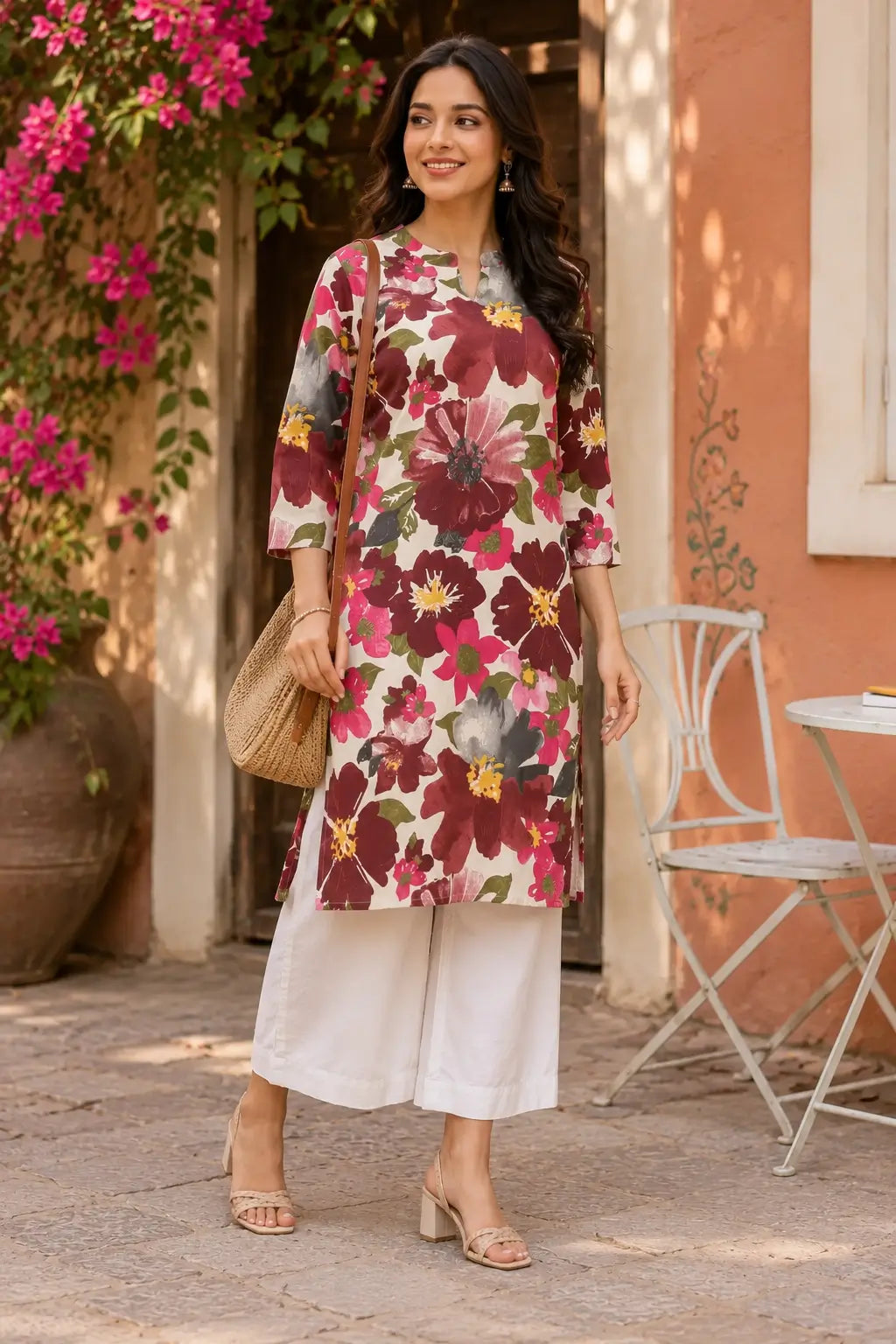
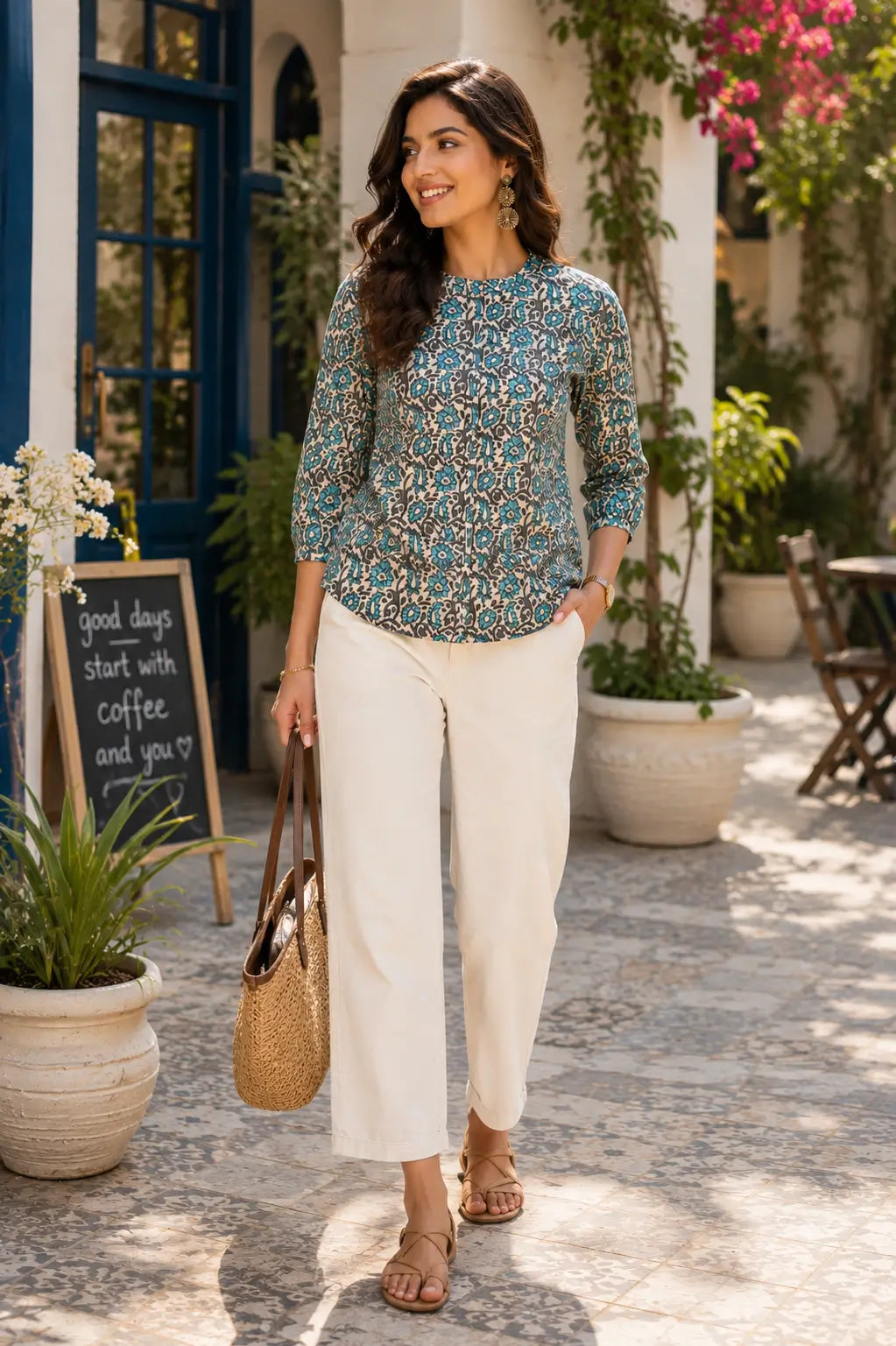
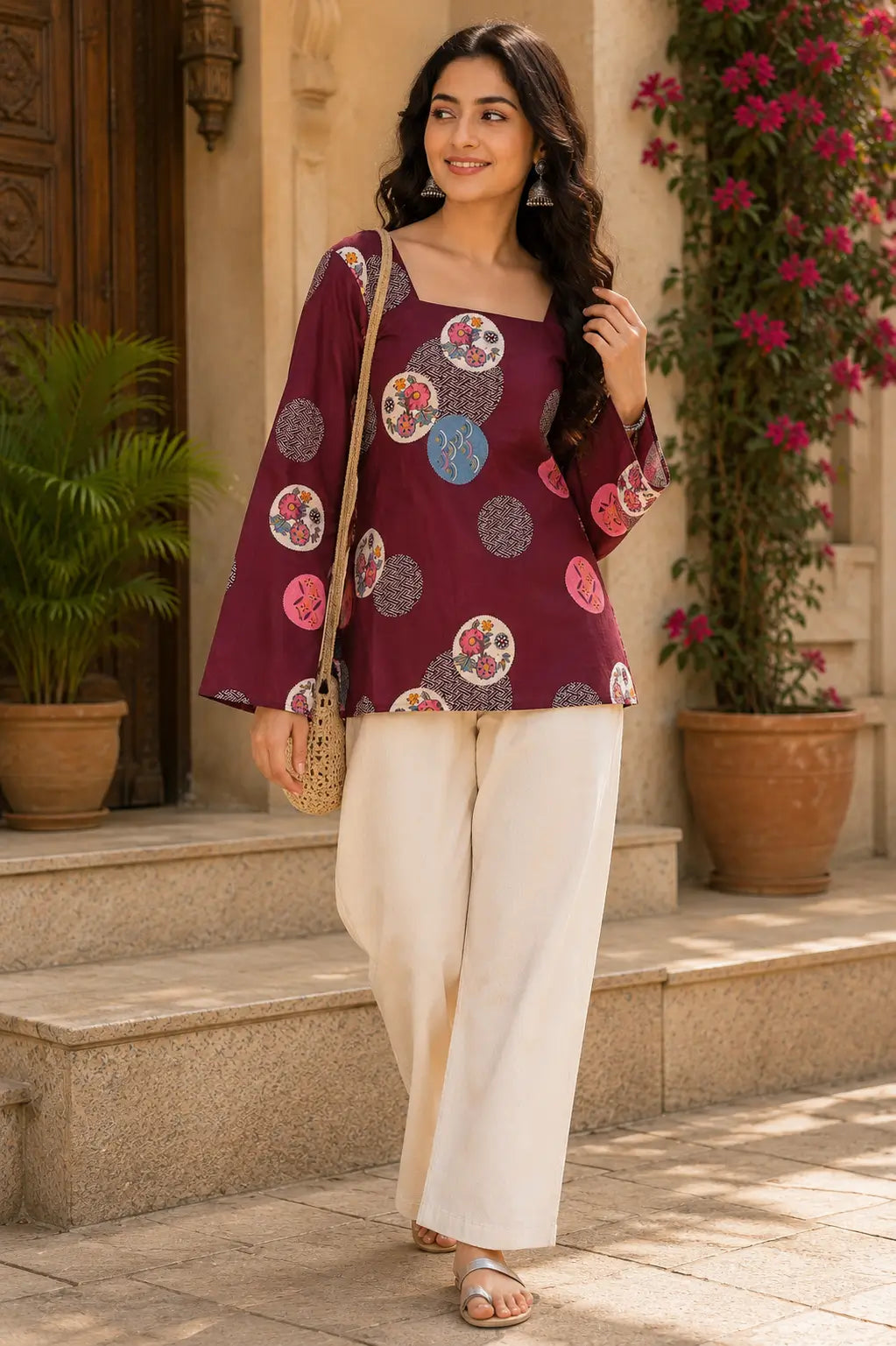


Quick answer: To choose a kurti for body shape, first identify where you need the most comfortable fit—bust, waist, shoulders or hips. Then select a silhouette that follows your proportions without pulling or restricting movement. A-line and panelled kurtis suit many women, straight cuts work with sufficient hip ease, and waist-defined styles help highlight natural curves. For co-ord sets, always check the measurements of both the top and bottom separately.
A beautifully styled outfit does not begin with hiding your body. It begins with understanding how a garment falls, where it needs extra ease and which proportions make you feel comfortable and confident.
That is especially important when choosing kurtis and co-ord sets online. Two women may wear the same labelled size but have different shoulder widths, bust measurements, waist placement, hip curves or heights. The same straight kurti can therefore fit one woman comfortably and feel restrictive on another.
This guide explains kurti styling for different body types without turning body-shape labels into rigid fashion rules. Pear, apple, hourglass and rectangle are simply useful starting points. They are not judgments about your body, and they should never prevent you from wearing a style you love.
The best kurti for your body type is ultimately one that:
- Fits comfortably at your widest measurement
- Allows you to sit, walk and raise your arms freely
- Does not pull across the bust or hips
- Falls cleanly without excessive fabric bunching
- Supports the silhouette you personally want to create
Why Does Body Shape Matter When Choosing a Kurti?
Quick answer: Body shape matters because garment fit depends on proportion, not only on size. Knowing whether your shoulders, bust, waist or hips are relatively wider helps you choose the right cut, ease, hem placement and bottom style. However, your measurements and the brand’s size chart remain more important than the body-shape label.
India’s national sizing research demonstrates why one universal clothing proportion cannot represent every woman. The official INDIA size project gathered 3D anthropometric data from more than 26,000 people aged 15 and above. Its measurement process collected approximately 100 body measurements per participant using whole-body scanning technology.
A female-specific analysis based on this national research scanned 13,045 women, of whom 12,492 were included as valid subjects. Participants were aged 15 to 70 and represented six geographical regions of India. Researchers identified four major Indian female body-shape clusters: bottom hourglass, hourglass, rectangle and trapezoid.
This research terminology does not match everyday labels such as pear or apple on a one-to-one basis. That is why these familiar labels should be treated as convenient styling language—not scientific categories into which every woman must fit.
What Research Tells Us About Clothing Fit
| Research evidence | Key finding | Practical meaning for shoppers |
|---|---|---|
| INDIAsize national project | More than 26,000 Indians were measured using 3D scanning. | Indian bodies vary too widely for one imported or universal proportion to fit everyone. |
| Indian female body-shape analysis | Of 13,045 female scans, 12,492 valid subjects produced four major national shape clusters. | Size and body shape must be considered together when assessing fit. |
| Physical garment-fit study | A 2023 study body-scanned 30 UK women aged 18–34 and found that women sharing a body-shape classification often reported similar fit concerns. | Knowing your proportion can help predict where a garment may pull, gape or feel loose. |
| Consumer sizing survey | In a survey of 687 US and UK readers, 91% reported brand-dependent sizing inconsistencies, while 43% said poor fit discouraged purchases. | Never rely only on S, M, L or XL when shopping online. |
The Indian anthropometric research is the most relevant evidence for Indian shoppers. The smaller UK study and the US–UK consumer survey provide useful context about fit behaviour, but they should not be treated as nationally representative Indian data.
Body Shape and Clothing Size Are Not the Same
Your body shape describes the relationship between different parts of your body.
Your clothing size is a brand’s label for a selected range of measurements.
For example, two women may both buy size L. One may need more room at the bust, while the other may need more room at the hips. Their preferred kurti cuts may therefore be different even though the size label is the same.
Similarly:
- Petite usually relates to height and vertical proportion, not weight.
- Curvy may describe a visible difference between the waist and bust or hips, but it is not one fixed shape.
- Plus size refers to a size range, not a single body shape.
- A woman can be petite and pear-shaped, tall and rectangular, or curvy with an apple-shaped proportion.
A useful styling decision must therefore consider three things together:
- Your measurements
- Your body proportions
- The look and comfort level you want
How Do You Identify Your Body Shape at Home?
Featured-snippet answer: Measure your bust, natural waist and fullest hip while wearing light clothing. Then observe the relationship between these measurements and your shoulder width. Hips wider than the upper body generally suggest a pear proportion; a fuller middle may suggest apple; balanced bust and hips with a defined waist may suggest hourglass; and similar upper, waist and hip lines may suggest rectangle.
Use a soft measuring tape and stand naturally. Do not hold your breath or pull the tape tightly.
Measure:
- Bust: Around the fullest part of your bust
- Natural waist: Around the narrowest or naturally folding part of your torso
- Full hip: Around the fullest part of your hips and seat
- Shoulder appearance: Observe whether your shoulder line looks wider, narrower or balanced compared with your hips
- Height and torso length: These affect kurti and top length even though they do not determine shape
Simple Body-Shape Identification Guide
| Common body-shape term | Typical visual relationship | Main fit priority |
|---|---|---|
| Pear shaped body | Hips appear fuller than shoulders or bust | Hip and thigh ease |
| Apple shaped body | More volume around the middle with a less-defined waist | Waist, stomach and bust comfort |
| Hourglass body shape | Bust and hips appear balanced with a visible waist | Maintaining balanced proportions |
| Rectangle body shape | Bust, waist and hips form a relatively straighter line | Creating or retaining clean structure |
| Inverted triangle | Shoulders or bust appear wider than hips | Shoulder fit and lower-body balance |
| Petite women | Shorter vertical proportions; may have any shape | Garment and sleeve length |
| Curvy women | Fuller bust, hips or both; may have any shape | Accurate bust, waist and hip measurements |
You may sit between two descriptions. That is completely normal. In that situation, follow the recommendations for the area that most often creates fit problems for you.
Kurti and Co-ord Set Comparison by Body Shape
| Body proportion | Kurti starting point | Co-ord set starting point |
|---|---|---|
| Pear | A-line, panelled or hip-friendly straight kurti | Detailed top with straight or relaxed pants |
| Apple | Soft straight, flared or vertical-panel kurti | Fluid top with a comfortable waistband |
| Hourglass | Shaped straight, wrap or gently waist-defined kurti | Balanced set with optional waist definition |
| Rectangle | A-line, asymmetric, yoke-detail or gathered kurti | Set with shape, layering or controlled volume |
| Inverted triangle | V-neck or simple-shoulder A-line kurti | Minimal top with wider or detailed bottoms |
| Petite | Clean vertical line and proportionate length | Monochrome or low-contrast set |
| Curvy | Structured but non-restrictive silhouette | Pieces with adequate bust and hip ease |
These are starting points rather than restrictions. A woman with a pear-shaped body can wear a straight kurti, and a woman with an apple-shaped body can wear a belted outfit. The important question is whether the particular garment has the required ease and falls where you want it to fall.
Best Kurti for a Pear-Shaped Body
Quick answer: The best kurti for a pear-shaped body usually provides comfortable hip room while bringing gentle visual interest to the neckline or shoulders. A-line, panelled and well-cut straight kurtis work particularly well when the hem does not pull across the fullest hip area.
A pear-shaped proportion generally has hips that appear wider than the shoulders or bust. Your first fit priority should therefore be the hip measurement.
Kurti silhouettes to consider
An A-line kurti gradually widens below the bust or waist, giving the hips more space without requiring an excessively oversized fit.
If you prefer silhouettes that give comfortable hip room without looking oversized, explore long kurtis for women with A-line, straight or panelled cuts. These styles are useful for daily wear because they create an easy vertical fall while keeping movement comfortable around the hips.
A panelled kurti can create a clean vertical fall while allowing controlled expansion around the lower body.
A straight kurti can also work well, provided its hip measurement and side slits allow comfortable movement. Do not reject straight styles automatically; simply check the garment width at the hips.
Necklines and upper-body details
Boat necks, square necks, collars, interesting yokes, subtle embroidery and statement sleeves can bring attention towards the upper part of the outfit.
This does not mean the lower body must always be hidden. It simply helps create visual balance when that is your preferred styling goal.
Best co-ord set for a pear-shaped body
Look for a co-ord set with:
- A top that has neckline, sleeve or shoulder interest
- Adequate width around the hip
- Straight, relaxed or gently wide-leg bottoms
- A waistband that sits comfortably without digging in
- Fabric that does not pull or form horizontal stress lines across the hips
A long co-ord top should ideally end above or below the fullest part of the hip rather than directly across it if you want a smoother vertical line.
Best Kurti for an Apple-Shaped Body
Quick answer: The best kurti for an apple-shaped body generally skims the middle without clinging or adding heavy bulk. Soft straight cuts, gentle A-lines, vertical panels, open necklines and side slits can create movement while maintaining comfort around the bust and waist.
An apple-shaped proportion commonly carries more volume around the bust or midsection, with a waist that may be less visibly defined.
The most important principle is not to choose the loosest garment available. Excess fabric can bunch around the torso and make movement less comfortable.
Kurti silhouettes to consider
A soft straight kurti creates a clean line when there is adequate ease at the bust and stomach.
A gentle A-line kurti can fall away from the middle without creating excessive flare.
A kurti with vertical panels, pintucks, an open placket or subtle centre detailing can guide the eye vertically.
A wrap-inspired or empire-detail kurti may also work, but check that gathers do not create unwanted volume directly over the fullest part of the torso.
Necklines and sleeves
V-necks, open collars, notched necklines and medium-depth round necks can visually open the upper body.
For apple-shaped proportions, a V-neck cotton long kurti for women can be a practical choice because the open neckline creates a cleaner vertical line while the regular long fit keeps the outfit comfortable for daily wear, office hours and casual outings. Pair it with straight pants or palazzos for a balanced everyday look.
Three-quarter sleeves often create a comfortable break near the waist area, although the right sleeve length ultimately depends on your height and personal preference.
Best co-ord set for an apple-shaped body
Choose a co-ord set with:
- A non-clinging top
- Enough room around the bust and stomach
- A comfortable elasticated, drawstring or flat-front waistband
- Straight or gently tapered trousers
- A top length that allows comfortable sitting
- Minimal bulky layering around the middle
A completely matching print can create an uninterrupted vertical column. A contrasting top and bottom can divide the body visually, so choose between the two effects according to the look you prefer.
Best Kurti for an Hourglass Body Shape
Quick answer: The best kurti for an hourglass body shape maintains the natural balance between the upper and lower body. Shaped straight kurtis, wrap styles, princess seams and subtle waist definition can highlight this proportion without requiring a tight fit.
An hourglass proportion usually has a bust and hip line that appear balanced, with a more visibly defined waist.
The most common online-shopping difficulty is that a garment may fit the bust and hips but remain loose at the waist. A garment-fit study also found that some hourglass participants reported looseness around the stomach even when other areas fitted more closely.
Kurti silhouettes to consider
A shaped straight kurti follows the body without becoming body-hugging.
An angrakha or wrap-style kurti introduces diagonal movement and adjustable waist definition.
A kurti with princess seams, a shaped waist or a soft tie can follow natural curves.
A-line kurtis also work, particularly when the flare begins gradually rather than creating unnecessary bulk at the waist.
Best co-ord set for an hourglass body shape
Balanced co-ord sets often work well when the top and bottom have similar visual weight.
Consider:
- A defined but comfortable waistband
- A tucked, semi-tucked or waist-length top
- A tie-waist top that can be adjusted
- Straight or gently wide-leg trousers
- Matching pieces that follow rather than compress the body
Very boxy tops can conceal the waist, which may be desirable for a relaxed look. Choose waist definition only when you personally want to highlight it.
Best Kurti for a Rectangle Body Shape
Quick answer: The best kurti for a rectangle body shape depends on whether you want to retain a clean straight silhouette or create more visual shape. A-line kurtis, curved hems, waist ties, yoke details, pleats and controlled gathers can introduce dimension without compromising comfort.
A rectangle proportion generally has a subtler difference between bust, waist and hip lines.
This body shape offers considerable styling flexibility because you can either celebrate a long, clean line or use garment construction to create additional definition.
Kurti silhouettes to consider
For a structured appearance, choose:
- Straight kurtis with crisp side seams
- Shirt-style kurtis
- Long vertical panels
- Minimal monochrome designs
For additional shape, consider:
- A-line kurtis
- Peplum-inspired kurtis
- Angrakha styles
- Yoke gathers
- Curved or asymmetric hems
- Optional belts or waist ties
Best co-ord set for a rectangle body shape
A co-ord set can create dimension through proportion rather than tightness.
If you want a little shape and softness without choosing a tight outfit, a floral cotton slub co-ord set can work well. The V-neck detailing, relaxed kurta fit and palazzo-style bottom add visual interest while keeping the outfit comfortable for everyday plans, brunches and light festive styling.
Useful combinations include:
- A shorter top with high-rise wide-leg trousers
- A longer top with slim-straight pants
- A structured shirt with fluid bottoms
- A fitted inner layer with a relaxed overshirt
- Contrasting textures within the same colour family
Avoid combining an extremely oversized top with extremely oversized bottoms unless a deliberately voluminous silhouette is your goal.
Best Kurti for an Inverted-Triangle Body Shape
An inverted-triangle proportion usually has shoulders or a bust line that appears wider than the hips.
If you want to create visual balance, keep the upper area relatively clean and introduce movement, print or width lower down.
Kurti silhouettes to consider
V-neck, U-neck and simple open-neck designs can create a vertical break through the upper body.
A-line, flared and panelled kurtis introduce gentle width below the waist.
Raglan sleeves, clean shoulder seams and softer fabrics can feel less visually structured than heavily padded or highly embellished shoulders.
Best co-ord set for an inverted-triangle shape
Consider:
- A relatively simple top
- Straight, flared, palazzo or wide-leg trousers
- Printed or detailed bottoms
- A longer top with side slits
- Dark-to-light or simple-to-detailed movement from top to bottom
You do not have to avoid statement sleeves or broad necklines. Use them whenever you want to emphasise your shoulders rather than visually balance them.
Best Kurti Styles for Petite Women
Quick answer: Petite women should prioritise proportion rather than trying to appear taller at all costs. Correct shoulder placement, sleeve length, kurti length and print scale usually matter more than the body-shape label.
Petite is a height-related category and can exist with any body shape.
A kurti designed for a taller frame may have:
- A waist seam that sits too low
- Sleeves that cover the hands
- Side slits beginning below the ideal point
- A hem that creates an unintended ankle-length effect
- Oversized motifs that dominate the frame
Petite-friendly styling ideas
A knee-length or slightly longer kurti can maintain visible leg length.
Small-to-medium motifs are often easier to carry than very large placements, although bold prints can still work when their scale and position feel intentional.
Monochrome kurtis and co-ord sets create a continuous line. Low-contrast footwear can extend that effect.
Vertical plackets, narrow panels and fine stripes can also support a longer visual line.
Most importantly, check the garment’s actual length in inches or centimetres rather than assuming “short,” “regular” or “long” will fit your frame.
Best Kurti and Co-ord Sets for Curvy Women
Quick answer: Curvy women should choose kurtis and co-ord sets using actual bust, waist and hip measurements rather than relying on labels such as loose fit or plus size. Look for adequate ease, strong seam placement, comfortable armholes and fabric that moves without clinging.
Curvy is not one body shape. A curvy woman may have pear, apple, hourglass, rectangle or another proportion.
The belief that every curvy woman should wear very loose clothing is unhelpful. Oversized garments may be comfortable, but poor shoulder placement and excessive fabric can also create bunching.
Look for:
- Shoulder seams that sit close to the shoulder point
- Armholes that allow movement without gaping
- Bust darts, princess seams or panels where appropriate
- Side slits for sitting and walking
- Sufficient hip width
- Waistbands that remain comfortable when seated
- Fabrics with enough substance to fall cleanly
If your bust corresponds to one size and your hips to another, choose according to the less flexible area of the garment. A kurti can often be adjusted at the waist more easily than it can be enlarged at the bust or hips.
For a ready-to-wear outfit that feels polished without extra styling effort, you can also explore women co-ord sets online with relaxed tops, comfortable waistbands and straight or wide-leg bottoms. These sets work well when you want both structure and easy movement in one outfit.
How to Choose a Co Ord Set for Body Shape
Featured-snippet answer: To choose a co ord set for body shape, compare your bust, waist and hip measurements with both pieces of the set. Select the size that fits the least flexible area, then use top length, trouser width, print placement and waist construction to create your preferred proportion. Do not assume that a matching set will fit equally well on the top and bottom.
Co-ord sets require an extra layer of attention because one size must frequently accommodate two different parts of the body.
1. Check the top and bottom separately
A woman may wear a medium top but need a large bottom, or vice versa.
Before ordering, compare:
- Bust with top measurement
- Shoulder width with top construction
- Top length with your torso and height
- Waist with the trouser waistband
- Hips with the widest bottom measurement
- Trouser length with your height and footwear
When the set is sold only in one combined size, fit the less flexible or fuller area first.
2. Decide where you want the visual break
A matching print from shoulder to ankle creates continuity.
A contrasting top and bottom create a visible horizontal division.
A short top with high-rise trousers draws attention towards the waist.
A long top with straight pants produces a more kurta-like vertical line.
None of these effects is universally better. Choose according to your styling goal.
3. Control where the volume sits
A simple practical formula is:
- Relaxed top + cleaner bottom
- Structured top + fluid bottom
- Shorter top + higher-rise bottom
- Longer top + straight or gently tapered bottom
Volume in both pieces can create a fashionable oversized silhouette, but it must still preserve movement and intentional proportions.
4. Prefer adjustability, but do not use it to replace correct sizing
Elasticated backs, drawstrings, waist ties and partial elastic can adapt to minor body fluctuations.
However, a stretch waistband cannot compensate for trousers that are too tight at the hips, and a waist tie cannot correct a top that pulls at the bust.
Consumer demand for adaptable garments is substantial: 81% of respondents in one US–UK sizing survey said they would pay more for clothing designed to accommodate body fluctuations. The sample is not representative of India, but it supports the practical value of adjustable construction.
Before choosing a co-ord set only by colour or print, it also helps to understand different types of co-ord sets for women, because casual, office, relaxed and occasion-ready co-ords all fall differently on the body.
Which Kurti Details Change the Overall Look?
| Garment detail | Visual or fit effect | What to check |
|---|---|---|
| V-neck or open neckline | Creates a vertical opening | Neck depth and bust coverage |
| Boat or square neckline | Adds horizontal upper-body emphasis | Shoulder width and innerwear coverage |
| Vertical panel or placket | Supports a longer visual line | Whether the panel sits straight |
| Waist tie | Adds adjustable definition | Tie placement relative to natural waist |
| Side slits | Improve movement and hip comfort | Slit height and bottom pairing |
| Curved or asymmetric hem | Breaks a strong horizontal line | Front and back coverage |
| Large placed motifs | Draw attention to a specific area | Motif position on your body |
| Small all-over print | Distributes interest more evenly | Print scale and colour contrast |
| Wide-leg bottom | Adds movement below the waist | Hip ease, rise and total length |
| Tapered bottom | Creates a cleaner ankle line | Calf and ankle comfort |
How Fabric Affects Kurti and Co-ord Set Fit
Fabric can change how the same silhouette appears and feels.
A crisp fabric may hold an A-line or structured shape more clearly. A soft, fluid fabric generally follows curves more closely. A very lightweight fabric may need lining, while a thick fabric may add more structure than expected.
Cotton and cotton blends
Lightweight cotton is widely chosen for everyday wear, but the word “cotton” alone does not tell you everything.
Check:
- Fabric thickness
- Weave density
- Whether the garment is lined
- Whether it has been pre-washed
- Whether the fabric softens after washing
- Whether the cut has enough movement allowance
Cotton poplin may appear crisper, while cotton slub or mul cotton may create a softer, more relaxed surface.
Rayon and viscose-based fabrics
These fabrics often have a more fluid fall. They can work well for softly flared kurtis and relaxed co-ord sets.
Because fluid fabrics follow the body more closely, correct bust and hip ease remains important. A garment that is technically loose may still show pulling if the cut is narrow at one point.
Crepe and other flowing fabrics
Crepe can support straight, flared and draped silhouettes. The result depends on its weight, stretch and lining.
Do not judge comfort only by the fabric name. Construction, thickness, finish and garment measurements matter just as much.
How Do You Choose the Right Kurti Size Online?
Featured-snippet answer: Measure your bust, natural waist and fullest hip, then compare them with the product-specific size chart. Confirm whether the chart shows body or garment measurements. Choose the size that safely accommodates the least flexible area, and check shoulder width, garment length, fabric stretch and desired ease before ordering.
A size label is only a starting point. Even within one wardrobe, a woman may need different sizes for a fitted kurti, an A-line kurti and a relaxed co-ord set.
Online size checklist
| What to verify | Why it matters |
|---|---|
| Body or garment measurement | Garment measurements normally include ease; body measurements do not |
| Bust measurement | Prevents pulling, gaping and restricted arm movement |
| Hip measurement | Essential for straight kurtis, long tops and trousers |
| Shoulder width | Affects sleeve fall and upper-body fit |
| Kurti length | Changes according to height and torso length |
| Bottom rise | Affects where the waistband sits |
| Fabric stretch | Determines how forgiving the garment may be |
| Model height and size | Helps estimate length, but does not replace your measurements |
| Exchange policy | Important when trying a new cut or brand |
What should you do when you are between sizes?
For a non-stretch fitted garment, the larger size is often the safer choice.
For a generously cut or highly flexible garment, the smaller size may work if all your measurements remain within the chart.
Consider which area is hardest to alter:
- A loose waist may be adjustable.
- A slightly long hem may be shortened.
- A tight bust or hip area is more difficult to enlarge.
- Narrow armholes are difficult to correct without affecting the sleeve.
The Five-Movement Fit Test
After receiving a kurti or co-ord set, do not judge it only while standing in front of a mirror.
Perform these five movements:
- Raise both arms above your head.
- Cross your arms in front of your chest.
- Sit naturally for at least one minute.
- Take several long walking steps.
- Bend gently as you would during everyday activity.
A comfortable outfit should not ride up excessively, restrict breathing, pull sharply at the seams or require continuous adjustment.
Also observe:
- Horizontal lines across the bust or hips may indicate tightness.
- A side seam moving towards the front or back may indicate uneven tension.
- A neckline standing away from the body may indicate excess fabric or incorrect shoulder fit.
- A waistband that feels comfortable while standing may still feel tight while seated.
A Simple Formula for Choosing the Best Kurti for Your Body Type
Use this five-step decision formula whenever you shop:
Step 1: Identify your fit priority
Where do ready-made garments usually feel tight or loose—shoulders, bust, waist, hips, thighs or length?
Step 2: Choose your desired silhouette
Do you want a straight, flowing, waist-defined, structured or oversized look?
Step 3: Match the garment construction
Select A-line, straight, wrap, panelled, asymmetric or shirt-style construction according to that goal.
Step 4: Check actual measurements
Verify bust, waist, hip, shoulder and length rather than relying on the size label.
Step 5: Evaluate real-life comfort
Think about where you will wear the outfit. Office travel, metro commutes, long sitting hours, festive events and casual errands may require different levels of ease.
Once you understand your body shape and preferred silhouette, styling becomes much easier. For more practical outfit combinations, you can also read our guide on how to style a kurti for daily wear, where we explain simple kurti looks for office, college, errands and casual days.
This method is more reliable than choosing an outfit solely because it has been labelled suitable for a particular body shape.
Common Mistakes to Avoid
Choosing only by the size label
A familiar size may fit differently across brands, garment categories and fabrics. Always reopen the current product’s size chart.
Assuming oversized automatically means comfortable
An oversized kurti may still have narrow armholes, tight sleeves or insufficient hip width. Comfort depends on construction, not only on overall volume.
Ignoring the widest measurement
For straight kurtis and co-ord trousers, the hip measurement can determine whether the garment falls cleanly.
Choosing a co-ord set by the top alone
The trousers may have a different fit requirement. Check both pieces before deciding.
Treating your body-shape label as permanent
Weight distribution, muscle, age, posture and life stages can change proportions. Re-measure periodically instead of shopping from an old assumption.
Following “flattering” rules that make you uncomfortable
A theoretically balancing silhouette is not useful if you dislike wearing it. Personal style and physical comfort should remain the final decision-makers.
Why Choose RABRIC for Everyday Kurtis and Co-ord Sets?
RABRIC’s current online collections include long kurtis, short kurtis, daily and office-wear styles, and coordinated sets positioned around comfortable fits, breathable fabrics and everyday versatility. Use the measurement and silhouette principles in this guide while exploring the collection, and shortlist outfits according to your real fit priority rather than a size label alone.
Soft CTA: Explore the kurtis and co-ord sets, compare the product measurements with your own, and choose the style that feels most natural for your everyday routine.
People Also Ask
Which kurti style suits most body shapes?
A gently shaped A-line or panelled kurti suits many body shapes because it provides upper-body structure and increasing room towards the hips. However, shoulder fit, bust ease, length and fabric remain important.
Can a pear-shaped woman wear a straight kurti?
Yes. A pear-shaped woman can wear a straight kurti when its hip measurement is generous enough and the side slits allow easy movement. Choosing the correct width is more important than avoiding the silhouette.
Do long kurtis make you look taller?
Long kurtis can create a continuous vertical line, especially when paired with low-contrast bottoms. The effect also depends on hem length, print placement, side slits and your overall proportions.
Should a co-ord set be loose or fitted?
A co-ord set should follow the intended silhouette without restricting movement. A relaxed set can still have a well-fitted shoulder, while a shaped set should still provide sufficient bust, waist and hip ease.
What neckline is most versatile for kurtis?
Medium-depth V-necks, open round necks and simple notched necklines work across many proportions. The best neckline also depends on bust coverage, shoulder width, jewellery and personal comfort.
Are matching co-ord sets suitable for curvy women?
Yes. A continuous matching colour or print can create a polished vertical line. Curvy women should focus on separate top and bottom measurements, comfortable waist construction and sufficient bust and hip ease.
Final Takeaway
Choosing a kurti for body shape is not about correcting your body. It is about understanding garment proportion.
Begin with the place where clothing most often feels tight or loose. Choose a silhouette that gives that area enough room. Then consider neckline, sleeve, fabric, hem and bottom style according to the look you want.
For a pear-shaped body, hip ease may be the priority. For an apple-shaped body, comfortable movement around the bust and middle may matter most. An hourglass figure may need balanced bust-and-hip fit with optional waist definition. A rectangle body shape may choose either a clean straight line or added dimension. Petite and curvy women should focus on length, construction and actual measurements rather than broad labels.
The best kurti for your body type is not necessarily the style that follows the most fashion rules. It is the one that fits without pulling, supports your daily movement and makes you feel like yourself.
Author Bio
Aditi Garg is a women’s ethnicwear and daily-wear apparel specialist focused on fabric selection, comfort-led silhouettes and garment fit for Indian conditions. Through hands-on product development and customer feedback, she studies how fabrics, construction and sizing perform in real-world use. Her writing helps women make practical and confident clothing choices.
Frequently Asked Questions
1. Which fabric is best for a daily-wear kurti?
Lightweight cotton and comfortable cotton blends are popular for regular use, particularly when the fabric is not overly thick or heavily lined. Rayon, viscose and soft crepe can provide a more fluid fall. Check fabric weight, transparency, care instructions and construction rather than relying only on the material name.
2. How should I choose a kurti when my bust and hip sizes fall into different sizes?
Select the size that accommodates the less flexible or fuller area. For a straight kurti, this may be the bust or hip. A slightly loose waist can often be adjusted more easily than a tight bust or hip area.
3. What should I check before buying a co-ord set online?
Check the top’s bust, shoulder and length measurements as well as the bottom’s waist, hip, rise and length. Also review fabric stretch, waistband construction, product images and exchange conditions.
4. Is an A-line kurti suitable for daily and office wear?
Yes. A moderately flared A-line kurti can provide movement while maintaining a polished shape. For office wear, choose practical sleeve lengths, subtle prints, manageable flare and fabric that does not crease excessively during sitting.
5. What should I do if I cannot identify my body type?
Do not force yourself into one label. Note where garments generally pull, gape or feel loose, and choose your silhouette according to that fit priority. Your measurements and comfort provide more useful shopping information than a perfect body-shape classification.
Research Sources Used for the Blog
This guide draws on the official INDIAsize national anthropometric project; the 2024 NIFT-led analysis of body shapes among Indian women; a 2023 garment-fit study published in the Journal of Fashion Marketing and Management; and a 2025 Vogue Business consumer sizing survey. The body-shape styling recommendations and two-layer fit method presented above are an original editorial synthesis developed for this article rather than rules reproduced from the cited studies.

