
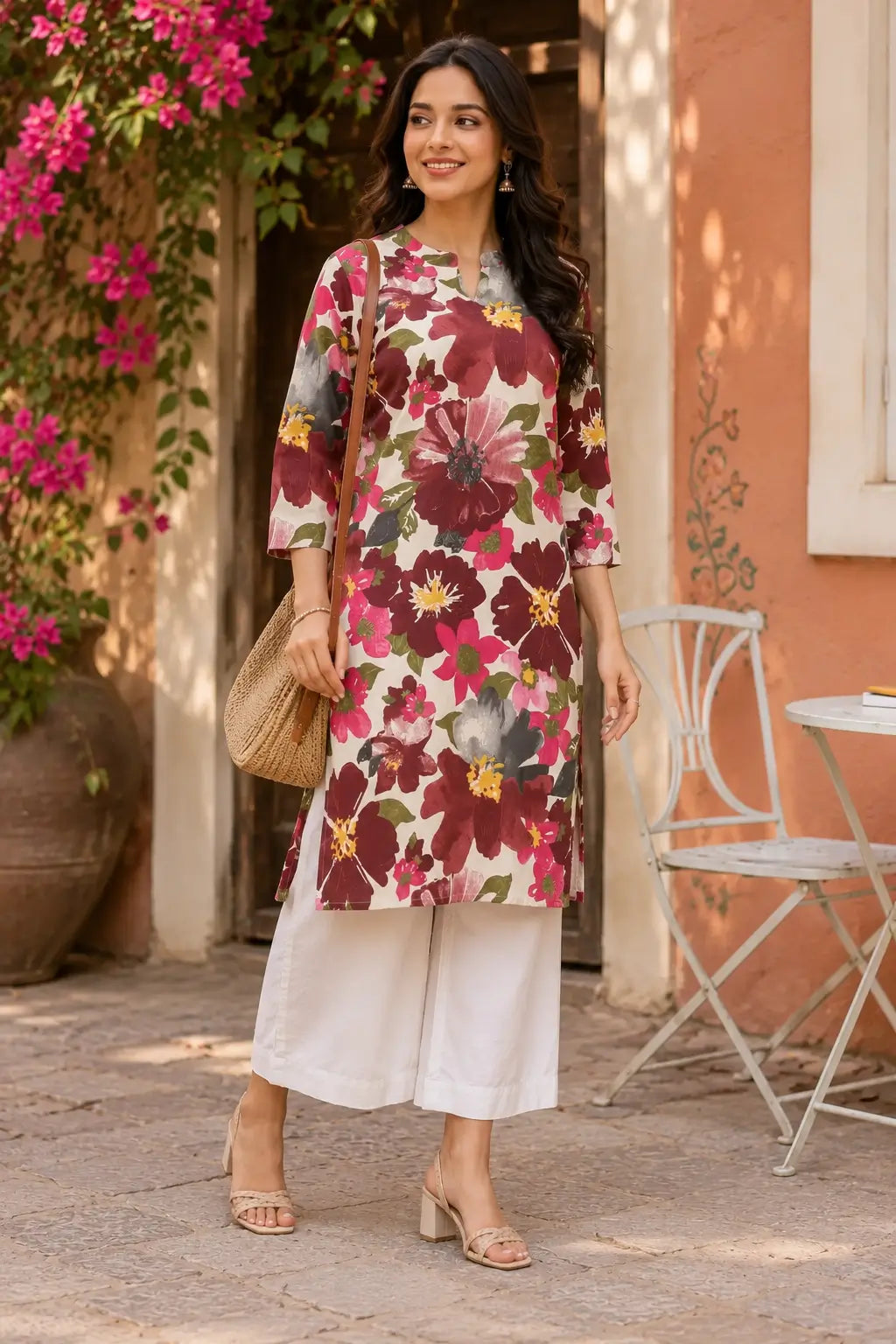
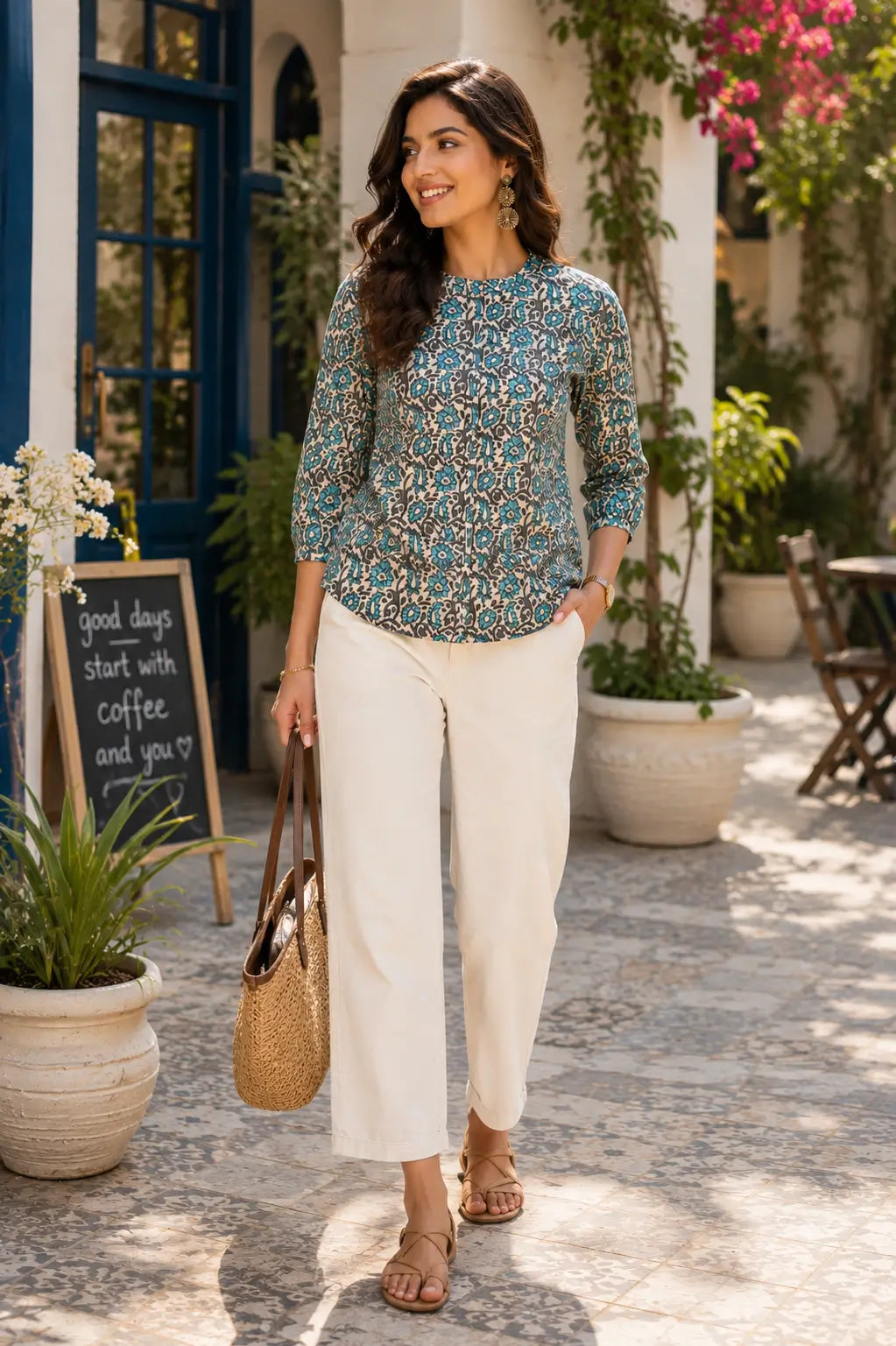
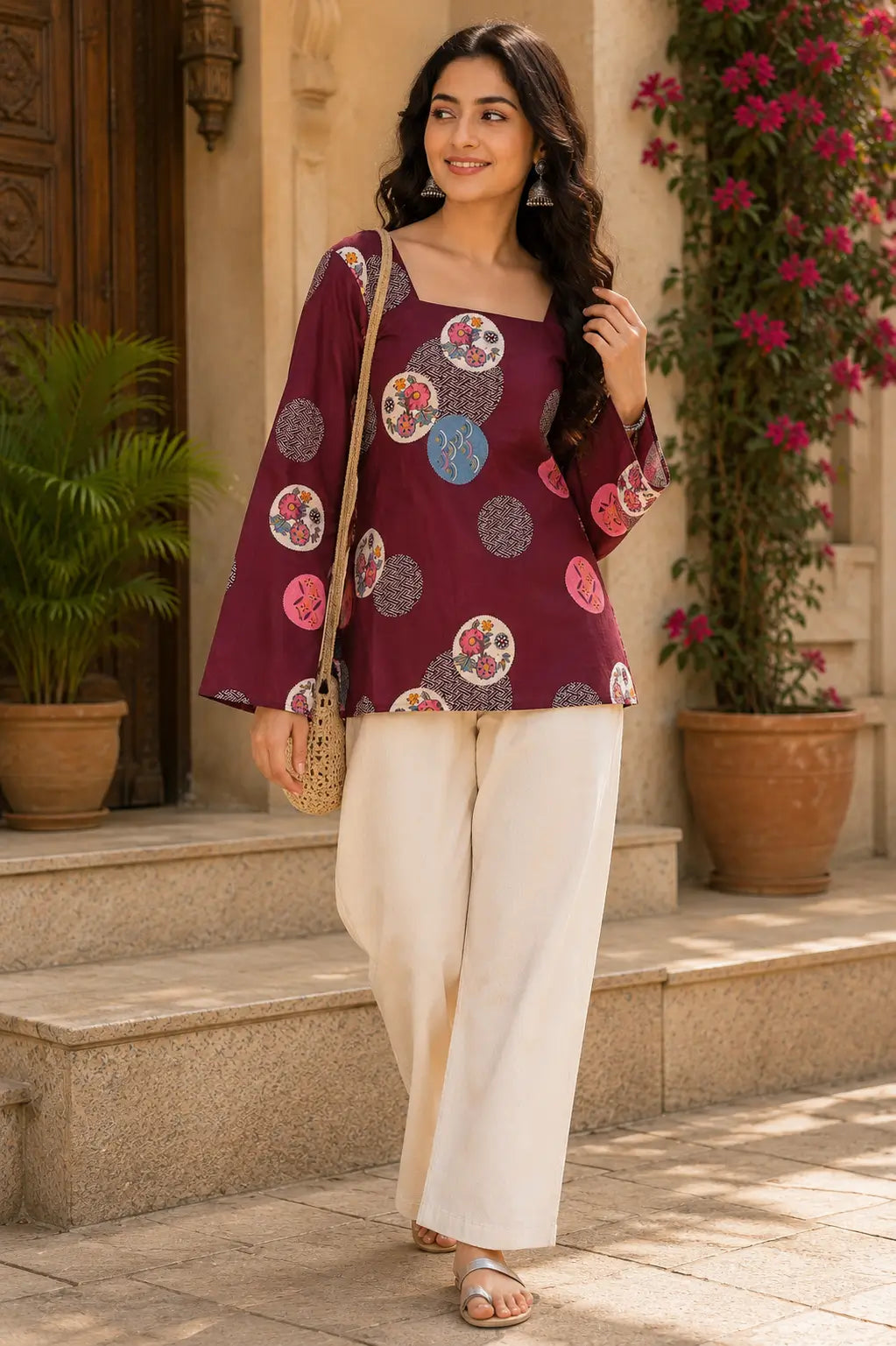


Quick answer: The most comfortable Delhi summer outfit for women is a loose, unlined cotton or cotton-rich kurti paired with breathable straight pants or palazzos. Choose a relaxed armhole, a comfortable waist, light or medium colours, minimal embroidery and as few layers as possible. Keep the dupatta optional, especially for metro travel. During peak heat, avoid heavy lining, tight synthetic garments, stiff waistbands and dense embellishment.
Government heat-health guidance also recommends thin, loose cotton clothing, preferably in lighter colours, along with head coverage when stepping into direct sun.
Delhi summer has very little patience for clothes that only look comfortable in photographs.
An outfit may appear light and flowy while you are standing in front of a mirror. Then you step outside. The sleeves begin to stick, the waistband feels tighter, the dupatta becomes another thing to manage, and by the time you reach the metro station, you are already planning what to change into when you get home.
That is why choosing Delhi summer outfits for women requires more thought than simply buying the thinnest fabric available.
A practical outfit has to handle several conditions in one day: direct afternoon sun, a crowded metro, an auto ride, an air-conditioned office, dusty roads and, by June, sudden humidity or rain. The best outfit is one that remains comfortable through these changes without looking too casual for work or everyday outings.
This Delhi summer fashion guide for women explains what actually works. It covers fabrics, fits, kurti styles, office outfits, daily-wear combinations and the small garment details that make a surprisingly big difference.
Why Delhi Summer Needs a Different Outfit Strategy
Delhi does not move smoothly from pleasant weather to summer. The heat can rise sharply, and the difference between morning, afternoon and evening can be uncomfortable.
The India Meteorological Department considers heat-wave conditions in the plains only after maximum temperature reaches at least 40°C, with additional criteria based on the departure from normal or the actual maximum temperature. IMD also identifies May as the peak heat-wave month in India.
The 2026 monthly weather reports show why clothing decisions matter.
Original Editorial Analysis of Delhi Weather: April to June 2026
| Month | Mean Maximum at Safdarjung | Highest Reported Across Delhi Stations | Heat-Wave Days Noted | Safdarjung Rainfall Departure |
|---|---|---|---|---|
| April 2026 | 37.1°C | 44.5°C | 3 days | 84% above normal |
| May 2026 | 39.5°C | 46.5°C | 6 days | 43% below normal |
| June 2026 | 39.2°C | 44.7°C | 2 days | 44% below normal |
Source note: The figures above are compiled from the official IMD monthly reports for April, May and June 2026.
What this data tells us
Across these three months, the monthly mean maximum temperature averaged 38.6°C. IMD reports noted heat-wave conditions on a combined 11 days, while the highest temperature reported across Delhi stations reached 46.5°C in May.
This is an original calculation based on the three IMD reports, not a weather forecast.
The rainfall pattern also changed sharply. April was wetter than normal at Safdarjung, while May and June were considerably drier than their long-period averages. That means a Delhi summer wardrobe cannot be planned for heat alone. It should also cope with dust, occasional rain, warm evenings and changing humidity.
High humidity deserves particular attention. IMD explains that humidity slows the evaporation of sweat, reducing the body’s ability to cool itself efficiently. That is why an outfit that feels fine in dry April heat may suddenly feel sticky and uncomfortable in humid June weather.
What Should Women Wear in Delhi Summer?
QUick answer: Women should wear lightweight, unlined and loose-fitting ethnic clothes in Delhi summer. A breathable cotton kurti, straight pants or palazzos, comfortable sleeves and an optional light dupatta make a practical combination. Avoid tight fits, thick lining, heavy embroidery and unnecessary layers during May and June.
The word loose does not mean shapeless or oversized.
It means there should be enough room around the underarms, bust, waist and hips for movement and airflow. A garment can still have a clean shoulder line and flattering shape while remaining comfortable.
Research on clothing comfort also suggests that fit, fabric construction, air permeability and the space between skin and clothing affect how heat and moisture move. Fibre content matters, but it is not the only factor.
The Five-Part Delhi Summer Outfit Formula
1. Start with Fabric, Not Decoration
Before looking at the print, neckline or embroidery, read the fabric details.
A beautiful kurti made from a dense, heavily lined fabric may remain uncomfortable even if it has short sleeves. A simple cotton kurti with a breathable weave and comfortable fit may perform much better during a full day outside.
For regular summer wear, look for:
- Lightweight cotton or cotton-rich fabric
- Soft cotton flex with a breathable construction
- Airy cotton cambric, mulmul or voile
- Loose rayon or viscose for fluid indoor and evening outfits
- Cotton-linen or linen blends for structured office looks
Do not depend only on a fabric name. Two cotton garments can feel completely different if one is thick, tightly woven and lined while the other is lightweight and unlined.
2. Leave Space Around High-Heat Areas
The underarms, back, neck, waist and inner thighs often feel uncomfortable first.
Choose armholes that do not cut into the skin. The kurti should not pull across the bust when you raise your arms. Pants should remain comfortable when you sit for twenty minutes, not only when you stand in front of a mirror.
Research in hot-weather sports clothing suggests that loose-fitting garments may improve airflow and heat dissipation compared with tight clothing, although actual comfort still depends on fabric, activity and garment construction.
3. Reduce Unnecessary Layers
Every extra layer affects comfort.
A lining may be useful when the outer fabric is transparent, but a full polyester lining under a cotton kurti can defeat the purpose of choosing cotton. Look for opaque fabric, partial lining or a lightweight cotton lining where possible.
Similarly, a dupatta should solve a purpose. It may provide sun coverage, modesty or protection inside an overcooled office. It should not become a compulsory third layer on every summer outfit.
4. Choose a Bottom That Moves With You
Very tight leggings are easy to style, but they can become uncomfortable during long commutes and seated office hours.
Straight pants, relaxed trousers, narrow palazzos and soft elastic-waist pants usually allow better movement. The waistband should sit securely without digging into the body.
For metro and market travel, ankle-length or slightly cropped trousers are easier to manage than floor-touching palazzos.
A ready-matched outfit can follow the same comfort rule. This pink cotton slub kurta pant set for women combines a straight kurta with relaxed pants, a soft elastic waistband and a practical side pocket. It is a useful option for office hours, college, travel and everyday summer routines when you want a complete outfit without adding a heavy dupatta.
5. Keep the Outfit Easy to Repeat
A useful summer outfit should survive regular washing and still be easy to style.
If a kurti requires special ironing, a separate inner layer, a complicated dupatta and a specific pair of bottoms, it may not become part of your real daily wardrobe.
The best comfortable summer outfits for women are usually the ones that can be worn again with different pants, footwear or accessories.
Best Fabrics for Delhi Summer
Quick answer: Lightweight cotton, cotton cambric, breathable cotton flex and airy cotton-linen fabrics are practical for Delhi summer. Rayon or viscose can also work for loose, fluid outfits, especially indoors. Fabric thickness, weave, lining, fit and moisture transfer matter as much as the fibre name.
Summer Fabric Comparison Table
| Fabric | Best Use | Main Advantage | What to Check |
|---|---|---|---|
| Lightweight cotton | Daily wear, office, commute | Familiar feel and practical breathability | Opacity, shrinkage instructions and lining |
| Cotton cambric or mulmul | Very hot days and casual wear | Light and airy | May require lining if too sheer |
| Cotton flex | Office kurtis and structured daily wear | Offers shape with everyday comfort | Exact composition and fabric thickness |
| Rayon or viscose | Indoor work, evenings and fluid co-ords | Soft drape and moisture absorption | Avoid very clingy cuts and heavy fabric |
| Cotton-linen blend | Office and smart casual wear | Airy with a polished structure | Creasing and wash care |
| Polyester-heavy fabric | Short wear, travel or quick-dry use | Often easy to maintain and quick to dry | Air permeability, lining and skin feel |
Textile science does not support the idea that one fibre automatically wins in every situation. Comfort depends on the complete fabric system: fibre, yarn, weave, thickness, porosity, moisture absorption, drying behaviour and garment fit.
A 2024 climate-chamber study involving eight women compared rayon and polyester hijabs in hot-dry and warm-humid conditions. In the warm-humid setting, rayon was associated with lower skin temperature and better perceived comfort than polyester. However, this was a small study on head coverings, not a direct test of kurtis, so its findings should be treated as useful direction rather than a universal rule.
Is Cotton Always the Best Choice?
Cotton is a dependable starting point, but not every cotton fabric is automatically summer-friendly.
A thick cotton garment with dense embroidery may feel warmer than a lightweight, loosely woven blended fabric. A transparent cotton kurti that requires a synthetic inner layer may also become less comfortable than expected.
When comparing two cotton kurtis, choose the one that is:
- Lighter without being transparent
- Unlined or lined with breathable material
- Comfortable around the armholes and shoulders
- Easy to wash frequently
- Loose enough to move but not excessively oversized
Is Rayon Good for Delhi Summer?
Rayon can be comfortable when the fabric is lightweight and the garment has a relaxed shape.
Its soft drape works well for co-ord sets, long kurtis and easy evening outfits. However, a very fitted rayon garment may cling when you sweat. A heavy rayon fabric may also feel less comfortable during a long outdoor commute.
Rayon is often more suitable for a day split between air-conditioned spaces and short outdoor travel than for several continuous hours in direct afternoon heat.
Are Synthetic Blends Always Bad?
No.
Some synthetic or blended fabrics are engineered for airflow and moisture movement. Others are dense, poorly ventilated or covered with heavy finishes.
Instead of rejecting every blended fabric, examine the garment itself. Hold it against the light. Feel its thickness. Check whether the lining is heavier than the outer fabric. Look at the armhole, sleeve width and overall fit.
The fabric label gives you one part of the answer. The construction gives you the rest.
Cotton Kurtis for Women in Summer: What to Check Before Buying
Cotton kurtis for women in summer are popular because they are easy to style, suitable for work and familiar to wear. But the word “cotton” on a product page is not enough.
Choosing cotton is only the first step. The weave, fabric weight, opacity and garment construction decide how a kurti will actually feel in real heat. For a more detailed explanation, read our guide to the best cotton kurtis for summer in India before comparing everyday options.
Use this six-point checklist.
1. Check the Full Fabric Description
Look for a clear fibre or fabric description rather than a vague phrase such as “summer fabric.”
When a garment is described as cotton flex, cotton blend or premium cotton, check whether the seller provides the exact composition or additional fabric details.
2. Look for Lining Information
A kurti may be cotton on the outside but lined with a less breathable material.
If the page does not mention lining, examine the photographs or ask before ordering. A lightweight lining may be useful for light-coloured garments, but unnecessary full lining can add warmth.
3. Compare Garment Measurements
Do not select a size only because you normally wear M, L or XL.
Compare the garment bust, waist and hip measurements with a kurti you already own and find comfortable. Check whether the size chart contains body measurements or finished garment measurements. They are not the same.
4. Study the Armhole and Sleeve Shape
A very small armhole can make even a loose kurti feel tight.
Three-quarter sleeves work well for sun coverage and office use when the sleeve is loose and the fabric is light. Sleeveless kurtis can feel comfortable indoors but may require a scarf, shrug or umbrella outdoors.
5. Check the Length for Your Routine
Calf-length and knee-length kurtis are practical for office and daily wear. Short kurtis are easy to pair with trousers or jeans, while long kurtis offer more coverage.
For rainy or humid days, avoid hems that touch the floor.
6. Read the Care Instructions
Summer clothes are washed more often. A garment that requires delicate handling after every wear may not suit a daily commute.
Check whether the fabric is colourfast, whether separate washing is advised and whether shrinkage has been addressed.
Best Delhi Summer Outfits Women Can Wear for Work, Travel and Daily Life
The best outfits for Delhi summer for women depend on where the day is being spent.
Outfit Comparison by Daily Situation
| Situation | Recommended Outfit | Why It Works | Avoid |
|---|---|---|---|
| Office with metro travel | Straight cotton kurti with ankle-length pants | Neat, breathable and easy to move in | Trailing dupatta and tight leggings |
| Auto or cab commute | Short or mid-length kurti with relaxed trousers | Easy to sit in and less fabric to manage | Stiff waistbands |
| College or errands | Printed cotton kurti with straight pants | Simple, washable and repeat-friendly | Very light sheer fabric |
| Work from home | Soft cotton or rayon co-ord set | No styling effort and comfortable movement | Heavy embellishment |
| Shopping or sightseeing | A-line kurti with breathable pants | Allows walking and offers coverage | Floor-length hems |
| Informal lunch | Unlined kurta-pant set | Looks complete without excessive layering | Thick festive dupatta |
| Humid evening | Fluid rayon kurti or co-ord | Soft drape and relaxed appearance | Body-hugging cuts |
Comfortable Ethnic Office Wear
For office wear, the goal is not to dress as lightly as possible. It is to remain comfortable while still looking polished.
A straight or slightly A-line kurti works well with ankle-length pants. Small floral prints, block prints, stripes and subtle geometric patterns can look professional while being more practical than completely plain light fabric.
Keep one light stole in your bag for strong office air-conditioning. It is more useful than wearing a thick layer throughout the commute.
Metro-Friendly Ethnic Wear
A packed metro changes what counts as a convenient outfit.
Avoid very wide sleeves that catch on bags. Choose secure necklines and manageable hems. A long flowing dupatta may look elegant, but it can become difficult on escalators, stairs and crowded platforms.
A short kurti with relaxed trousers or a calf-length straight kurti with ankle pants usually works better.
If your routine includes switching between the metro, an auto and an office cab, our guide to comfortable commute outfits for women explains how to choose practical lengths, sleeves, bottoms and light layers for the complete journey.
Comfortable Auto and Cab Outfits
When sitting for long periods, the waistband and hip fit matter more than they seem.
Choose pants with soft elastic, a partial elastic back or an adjustable drawstring. The kurti should not bunch heavily at the waist when seated.
A loose three-quarter sleeve can provide some sun coverage without adding a separate layer.
Easy Co-ord Sets for Summer
A co-ord set removes the daily question of what to pair with what.
For summer, choose a set with a relaxed top and trousers that are not tight around the thighs. Check that both pieces use the same comfortable fabric. Some sets have a lightweight top but a heavier bottom, so look closely at the description.
A simple printed co-ord can move from work to a casual meal with a change of footwear and earrings.
What to Wear in Delhi in May and June
May and June both feel hot, but they do not always feel the same.
What to Wear in Delhi in May
May is usually the month to prioritise direct-heat protection.
IMD’s May 2026 report recorded heat-wave conditions on six days, a mean maximum of 39.5°C at Safdarjung and a peak of 46.5°C at Ridge.
For May, choose:
- Lightweight cotton kurtis
- Loose sleeves or comfortable sleeveless styles
- Light or medium colours
- Straight pants with soft waistbands
- Minimal lining
- A breathable scarf, cap or umbrella for direct sun
Official health guidance advises carrying water, reducing outdoor activity during hotter parts of the day and wearing thin, loose cotton clothing.
Avoid planning a full outdoor day in a garment simply because it is labelled “summer wear.” Try to judge how it will feel after walking, sitting and travelling.
What to Wear in Delhi in June
June can bring a less predictable mix of heat, humidity, wind and rain.
IMD’s June 2026 report recorded a mean maximum of 39.2°C at Safdarjung, a peak of 44.7°C at Ridge and heat-wave conditions on two days. The report also recorded rain and squalls on multiple dates.
For June, consider:
- Printed fabrics that handle visible creasing or minor splash marks
- Ankle-length pants rather than floor-length palazzos
- Loose rayon, cotton or cotton-rich co-ords
- Fabrics that are not too transparent when damp
- Easy-wash garments that can dry without complicated care
- Footwear suitable for sudden rain
Humidity makes tight sleeves, heavy lining and fitted waistbands feel more noticeable. Add airflow through the cut rather than depending only on a thinner fabric.
Best Clothes for Delhi Summer and Humidity
Quick answer: The best clothes for Delhi summer and humidity are loose, unlined outfits with open necklines, roomy armholes and breathable fabric. Straight cotton kurtis, A-line kurtas, relaxed co-ords and ankle-length pants are practical. Avoid clingy fits, heavy synthetic lining and multiple layers.
Humidity changes how an outfit feels because sweat evaporates more slowly.
That makes the space between the skin and clothing more important.
A fitted kurti may be manageable in a cooled room but uncomfortable after walking ten minutes outside. A slightly relaxed cut allows the garment to move away from the skin instead of sticking to it.
Choose These Design Details
- Round, V-shaped or modest open necklines
- Roomy armholes
- Side slits for movement
- Straight or A-line silhouettes
- Soft elastic or adjustable waistbands
- Lightweight pockets rather than bulky pocket bags
- Sparse embroidery placed away from high-sweat areas
Be Careful With These Details
- High, tightly closed collars
- Thick embroidery around the neck
- Dense handwork across the chest
- Full synthetic lining
- Tight cuffs
- Heavy tassels or decorative layers
- Stiff, non-stretch waistbands
The 90-Second Delhi Summer Fit Test
This is a simple editorial test you can use in a trial room or immediately after receiving an online order. It is not a laboratory standard. It is a real-life comfort check.
Step 1: Raise Both Arms
Check whether the kurti pulls at the bust, shoulders or underarms.
If the full garment rises sharply or the armhole cuts into the skin, it may become uncomfortable during travel.
Step 2: Sit for 30 Seconds
Notice the waistband, stomach, hips and thighs.
A summer bottom should remain comfortable when seated. If you immediately want to loosen the waist, reconsider the size or cut.
Step 3: Walk Around
See whether the fabric clings between the legs or around the back.
Also check whether the side slits provide enough movement.
Step 4: Hold the Fabric Against Light
This helps identify transparency and lining needs.
A garment that requires a thick inner slip may become warmer than expected.
Step 5: Check the Neck and Back
Make sure the neckline is secure without sitting too close to the throat. Look for excess fabric gathering at the back, which can trap heat and feel bulky.
An outfit that passes at least four of these five checks is more likely to work in real daily use.
Daily Wear Outfits for Women in Delhi Summer
A summer wardrobe becomes easier when a few pieces work in several combinations.
You do not need a completely different outfit for every day. You need a small group of garments that can be repeated without looking repetitive.
Five Practical Outfit Formulas
| Day or Use | Outfit Formula | Simple Styling Change |
|---|---|---|
| Regular office day | Printed straight kurti with solid ankle pants | Add small studs and flats |
| Long commute day | Short cotton kurti with relaxed trousers | Carry a light scarf |
| Meeting day | Cotton-linen kurta with structured pants | Add a watch and closed footwear |
| Casual Friday | Soft co-ord set | Use a tote and minimal jewellery |
| Weekend errands | A-line kurti with palazzos | Add comfortable sandals |
On days when matching a separate kurti and bottom feels like extra work, comfortable co-ord sets for women can offer an easy, ready-matched option. For Delhi summer, check that both pieces feel lightweight and that the trouser waist and thighs remain relaxed while sitting, walking or travelling.
A useful rule is to keep one part of the outfit printed and the other part simple.
For example, a printed kurti can be worn with two or three different solid bottoms. A plain short kurti can work with printed pants, jeans or a palazzo. This gives more combinations without increasing wardrobe clutter.
Summer Ethnic Wear for Women: Colours, Prints and Sleeves
Are Light Colours Better?
Official Indian heat advisories recommend light-coloured clothing during extreme heat.
White, ivory, pastel blue, soft pink, beige, mint and lavender can work well in direct daytime heat. However, very pale clothes are not always the most practical choice for public transport, dust or sweat marks.
Medium-tone prints offer a useful balance.
Small florals, mixed prints, stripes and block prints can remain visually fresh while being easier to repeat and maintain.
Light-coloured summer wear does not have to look plain. A white base with soft blue floral motifs can feel fresh while still being practical for work and everyday styling. This light blue floral cotton long kurti for women shows how breathable cotton, a regular fit and three-quarter sleeves can come together in a simple summer outfit.
Can You Wear Black in Delhi Summer?
Yes, but use context.
A lightweight black cotton kurti with a loose cut may be comfortable for an evening outing or indoor office day. A tight black synthetic outfit in direct afternoon sun is a different experience.
Fabric, fit, lining and time of day still matter.
Which Sleeve Length Works Best?
There is no single correct sleeve length.
Sleeveless kurtis provide freedom around the arms but offer less sun coverage. Short sleeves are practical but may feel tight if the opening is narrow. Loose three-quarter sleeves offer coverage without requiring a separate layer.
For direct sun, a breathable three-quarter sleeve is often more practical than wearing a fitted sleeveless kurti with a heavy shrug.
Which Prints Work Best for Daily Wear?
Prints are not only decorative. They can make daily wear easier.
Fine florals, geometric patterns and block prints can disguise small creases and make sweat marks less noticeable than completely plain fabrics.
Very large, heavily placed motifs can sometimes make a garment harder to style repeatedly. Balanced all-over prints are usually more versatile.
How to Choose a Comfortable Fit for Your Body
Body type guides can become too rigid.
Instead of trying to “correct” your body, pay attention to where you need movement, where garments usually pull and which lengths feel balanced on you.
| Common Fit Concern | What to Look For |
|---|---|
| Full bust | Correct shoulder fit, enough bust room and a neckline that does not pull |
| Fuller hips | A-line shape, side slits and adequate hip measurement |
| Tummy sensitivity | Straight or gently flared kurti with a soft trouser waist |
| Broad shoulders | Clean shoulder seam and sleeves without heavy shoulder decoration |
| Petite height | Knee to mid-calf length and controlled volume |
| Tall height | Longer straight kurtis, calf lengths and proportionate prints |
| Thigh discomfort | Straight pants, relaxed trousers or narrow palazzos |
The correct size is the one that allows you to sit, walk and raise your arms comfortably.
Do not size down merely to create a fitted look. Do not size up several sizes without checking the shoulders either. Excess fabric can become bulky and may not improve comfort.
A well-fitted shoulder with comfortable body ease usually looks better than a garment that is tight everywhere or oversized everywhere.
Common Delhi Summer Outfit Mistakes
| Avoid | Choose Instead | Why |
|---|---|---|
| Heavy full lining | Opaque fabric or light partial lining | Reduces unnecessary layers |
| Tight synthetic leggings | Straight pants or relaxed trousers | Allows easier movement |
| Dense neck embroidery | Light or spaced detailing | Keeps the neckline less bulky |
| Floor-length palazzos | Ankle-length or controlled-width pants | Easier during rain and travel |
| Tight high collar | Open round, V or comfortable shirt collar | Less restrictive around the neck |
| Heavy dupatta | Light cotton stole or no dupatta | Easier for commuting |
| Buying by size label alone | Comparing actual measurements | Brand sizing can vary |
| Choosing only by photograph | Checking fabric, lining and fit details | Photos do not reveal full comfort |
Another common mistake is confusing “very thin” with “very comfortable.”
Extremely thin fabric may require an inner layer. It may also become transparent in daylight. A slightly more substantial but breathable cotton can be more practical than a sheer fabric worn over a synthetic slip.
How to Buy Summer Ethnic Wear Online Without Guessing
Online photographs can tell you about colour and silhouette. They do not always tell you how the fabric will behave at 3 p.m. in Delhi.
Before ordering, check the following.
Fabric Composition
Look for a specific fabric description. Save a screenshot if the product page contains detailed material information.
Garment Measurements
Compare the listed measurements with a comfortable garment you already own. Pay particular attention to bust, hip, shoulder, sleeve opening and pant waist.
Lining
Confirm whether the garment is unlined, partially lined or fully lined.
Product Photographs
Look at close-ups of the weave, neckline, sleeve and side slit. A video can also reveal how stiff or fluid the fabric is.
Customer Reviews
Prioritise reviews that discuss fabric thickness, transparency, shrinkage, fit and comfort after washing. A review that only says “beautiful” offers limited buying information.
Return and Exchange Terms
Check the time limit, condition requirements and whether a size exchange is available. Do this before ordering, not after discovering a fit problem.
Wash Care
Daily summer wear should be realistic to maintain. Read whether hand washing, separate washing or dry cleaning is required.
People Also Ask
What is the best outfit for Delhi summer?
A loose cotton kurti with straight or relaxed pants is one of the most practical options. Choose an unlined garment with comfortable armholes, minimal embellishment and a soft waistband.
What should tourists wear in Delhi during summer?
Tourists should wear breathable clothes that provide comfortable coverage and allow walking. A cotton kurti with ankle-length pants, comfortable footwear, sunglasses and a light scarf or hat works well for sightseeing.
Are kurtis more comfortable than jeans in Delhi heat?
A loose kurti with breathable pants is often more comfortable than thick, tight jeans. Lightweight relaxed jeans may still work for short outings, especially with a short cotton kurti or top.
Can women wear sleeveless clothes in Delhi summer?
Yes. Sleeveless outfits can feel comfortable indoors and during short outings. For prolonged direct-sun exposure, carry a light scarf, use an umbrella or choose loose sleeves for additional coverage.
Is a dupatta necessary in Delhi summer?
No. It depends on personal preference, the outfit, the setting and the amount of sun exposure. When needed, choose a lightweight cotton or mulmul dupatta rather than a heavy, slippery or heavily embroidered one.
What are the best ethnic outfits for Delhi hot weather?
Straight cotton kurtis, A-line kurtas, short kurtis with relaxed trousers, unlined kurta-pant sets and lightweight co-ord sets are practical ethnic outfits for Delhi hot weather.
How to Use This Guide While Shopping at RABRIC
Begin with your real routine rather than choosing only by colour.
For a long metro commute, start with lightweight kurtis and manageable pants. For a mostly indoor workday, a fluid co-ord or kurta-pant set may be more convenient. For regular errands, prioritise washable fabric, secure necklines and pockets.
The website currently organises options across kurtis, co-ord sets and kurta-pant sets, which makes it easier to compare silhouettes according to your routine.
Use the fabric, lining, fit and measurement checklist from this guide while exploring lightweight long kurtis for women for everyday routines, office wear and casual summer days.
A Clothing Guide Is Not a Heat-Safety Plan
Comfortable clothing can reduce irritation and make daily travel easier, but it cannot remove the risks of extreme heat.
During very hot days, follow official weather alerts. Carry drinking water, reduce unnecessary outdoor activity during peak afternoon hours and plan travel for cooler parts of the day where possible. The 2026 NCDC advisory also recommends drinking water even before strong thirst develops and carrying water while travelling.
Seek medical help if someone shows signs of serious heat-related illness, such as confusion, fainting or an unusually high body temperature.
Final Takeaway
The best Delhi summer outfit is not necessarily the thinnest, lightest or loosest garment you can find.
It is an outfit that balances five things:
Fabric, airflow, coverage, movement and practicality.
For most women, that means a breathable straight or A-line kurti, comfortable pants, minimal lining and an optional light layer. Cotton is a strong everyday choice, but fit and fabric construction matter just as much as the fibre name.
For May, prioritise direct-heat comfort and light layers. For humid June days, pay extra attention to armholes, waistbands, opacity and fabrics that do not cling.
Most importantly, choose clothes for the life you actually lead. An outfit should work when you are walking to the metro, sitting in an auto, spending hours at your desk and stopping for groceries on the way home.
That is what truly comfortable summer ethnic wear for women should do.
Frequently Asked Questions
Which fabric is best for a daily-wear summer kurti?
Lightweight cotton, cotton cambric and breathable cotton-rich fabrics are dependable for daily use. Choose based on fabric thickness, opacity, lining and fit rather than relying only on the word “cotton.”
How should I choose my kurti size when shopping online?
Compare the product’s garment measurements with a comfortable kurti you already own. Check the bust, hip, shoulder and sleeve opening. Confirm whether the chart shows body measurements or finished garment measurements before ordering.
Which kurti style is easiest for everyday summer wear?
Straight and slightly A-line kurtis are easy to pair and comfortable for work, travel and errands. Side slits, relaxed armholes and knee-to-calf lengths make them practical for movement.
Which summer outfit works best for different body types?
Choose according to fit needs rather than strict body-shape rules. A-line kurtis offer more hip room, straight kurtis create a clean line, and side slits improve movement. The shoulder should fit correctly while the bust, waist and hips have comfortable ease.
What should I check before buying summer ethnic wear online?
Check fabric composition, lining, garment measurements, sleeve opening, kurti length, pant waistband, wash care, customer reviews and the return policy. Close-up fabric photographs are especially useful for judging thickness and transparency.
About the Author
Aditi Garg is an ethnicwear fabric specialist with more than five years of experience in apparel design, fabric sourcing and daily-wear garment development. She specialises in breathable fabrics, climate-appropriate textiles and comfort-focused clothing for Indian conditions.
Through hands-on work with fabric suppliers and customer feedback, she studies how different materials perform in real-world use. Her writing focuses on helping readers understand fabric quality, durability and comfort when choosing everyday kurtis.
Research Sources Used for the Blog
Research sources used for this blog include the India Meteorological Department’s Delhi Monthly Weather Report for April 2026, Delhi Monthly Weather Report for May 2026, Delhi Monthly Weather Report for June 2026 and IMD FAQ on Heat Waves; the National Centre for Disease Control’s Public Health Advisory on Extreme Heat and Heatwaves 2026; the peer-reviewed review Clothing Thermophysiological Comfort: A Textile Science Perspective; the research paper The Role of Sports Clothing in Thermoregulation, Comfort and Performance During Exercise in the Heat; and the 2024 study Thermal Effects of Rayon and Polyester in Warm-Humid and Hot-Dry Environments.
